Reader’s Log: April 2025
In April, my reading included two novels from Australia. I hadn’t been intending to focus on a particular region of the world — it was serendipity and no more.
The reading experience was, I suppose, typical for me, inasmuch as struggled to like these books. I don’t quite understand what it is about me that asks so much of fiction (and nonfiction, for that matter). I’ve always felt that the best, smartest readers are both voracious and widely enthusiastic — whereas I am endlessly picky and rarely find books that I really love.
When living in Brooklyn (last time around in that borough), I was lucky enough to be able to go out to see music, dance, theater and movies quite frequently, pretty much every week, and over time I came to understand that, if you want to see something great, you have sit through a lot of middling stuff. But I didn’t mind the middling evenings because, often as not, they were evenings with my wife and friends, and we had dinner and conversation to enjoy even if the night’s entertainment was only so-so. Also, a middling jazz show or movie or live performance only lasts a couple hours — no great loss. Certainly not a significant investment of time.
With books, on the other hand, there seems to be ever-so much more investment: First of all, the choice of what to read is much more difficult — there are millions of volumes, tens of thousands of authors. Identifying what you might like or be interested in is a journey in and of itself. By comparison, even in a city as enormously varied as New York, there are only a couple dozen jazz shows to choose from (if you are looking for jazz) on any given night, and likewise a fairly limited set of choices for theater or dance or movies.
I think this must tie into what someone called “the paradox of choice.” (It might be better put as “the paralysis of choice.”) The more choice you have, the easier it is (for me, anyway) to try something and set it aside unfinished. Consider the difference between seeing a movie in a theater vs. streaming a movie at home. I have walked out of only a few movies in my life. With streaming, however, I have started and abandoned dozens or maybe hundreds of titles. Just this weekend I abandoned two of the three movies I tried to watch!
My reading abandonment rate is even greater than with streaming movies, and I think that must be because reading a book is a significantly larger time investment. Even the shortest novels require three hours or so to read–and most ask considerably more of you.
All this year, I have tried to be more patient with the books I read, with the expectation or hope that a deeper immersion in a work of art will ultimately pay off in greater enjoyment, enlightenment, or whatever it is that I am looking for as a reader.
And so this month’s books: I stuck with them. Two of them, anyway. And, having stuck with them, I would say that they stuck with me. That is, there are animating ideas or key images that I expect to remember indefinitely, and which in some way have made subtle changes in me, either in the way I see the world or think about things… something. I came away at least infinitesimally changed.
That doesn’t necessarily mean I liked them, though!
Question 7 by Richard Flanagan
Richard Flanagan is among the best-known, living, Australian novelists. He is almost certainly the preeminent novelist from the remote island-state of Tasmania.
The very fact of his roots in that distant place has always made him interesting to me, in the same way that “edge” places like Key West or the island of St. Kilda have always pricked my imagination. Tasmania really seems like the end of the line, the last stop before tumbling into the realm of Antarctica. Flanagan’s interest in the natural world and the history of Tasmania ought to practically guarantee that I would enjoy his books, even though they often are of a type (historical novels, basically) that I don’t like much. But for whatever reason, I never really engaged with his work when I picked it up. Both Gould’s Book of Fish and The Narrow Road to the Deep North didn’t connect with me, and I set them down unfinished.
His latest book, Question 7, however, I read from start to finish.
Question 7 is a mix of memoir, history, and essayistic philosophizing. For some reason, I opened it with the assumption that it was metafiction, and indeed the book almost immediately called to mind two recent genre-blurring metafictional novels (about which more below). But it seems to be labeled non-fiction, and now that I think back on it, when I picked it up at the McNally Jackson store in Soho, it was shelved amidst the memoirs. So, not metafiction, I guess! I will assume, then, that the details of the book are essentially factual. To wit: the author, now in his 60s and approaching the final stages of his life, makes a trip to Japan, essentially a hajj in the memory of his father, who nearly died as a prisoner of war in World War II. If not for the atomic bombing of Hiroshima and Nagasaki, Flanagan says, his father would have perished in Japan’s final effort to stave off defeat. In other words, the inhumanly cruel bombing not only saved Flanagan’s father’s life, but made Flanagan’s own life possible.
From there, Question 7 spirals into Flanagan’s memories of his boyhood in Tasmania, musings on the injustice of the European seizure of Australia, and, in parallel, the suffering of his Irish ancestors, who were shipped to Tasmania, then called Van Diemen’s Land, as convicts, and the attendant shame of those convicts’ descendants. The memories include offshoots regarding his boyhood deafness, his brush with death in a river rafting accident as a young man, the long torment of his mother, who had to care for her own ungrateful mother while raising her many children, the stoic silences of his father, who became a teacher after coming home from the war… and really just about anything that Flanagan cared to include from his long and apparently much varied life.
Ah, and that’s not all. Question 7 also includes a not-entirely brief record of the life and work of H.G. Wells, and in particular his affair with Rebecca West. The point of including Wells is that he imagined and foretold much of the horrors of the bombings that marked the end of World War II. And, for good measure, there is a similarly long consideration of the life of Leo Szilard, the Eastern European physicist whose work led to the development of the atom bomb (which he protested and hoped to prevent from being deployed.)
In short, this is a book about a Tasmanian novelist named Richard Flanagan and the things he is thinking about as he approaches old age. Okay.
I am sorry to say that the telling of that story (if “story” is the right word) is punctuated with the phrase, “Such is life.” A bomb drops, a whole swath of humanity is killed: “Such is life,” intones Flanagan. This happens again and again, especially in the first half of the book.
Does that sound familiar??? Yes, it’s exactly like the phrase “So it goes,” used to such great effect in Kurt Vonnegut’s Slaughterhouse-Five.
In fact, I wondered as I read Question 7, was it possible that Flanagan had never read the Vonnegut novel? Surely he wouldn’t be using this little narrative hiccup if he knew that Vonnegut had beaten him to it — in a book that was also about World War II — sixty years ago? He couldn’t have known! How embarrassing for him! Yes, I actually felt a twinge of embarrassment for Flanagan, for not knowing such a foundational bit of modern novel-writing.
But later on in Question 7, Flanagan mentions Slaughterhouse-Five by name. So he did know about it. And yet he went ahead and sprinkled his somehow blander catchphrase in his own novel, never mind that it can’t help but strike the reader as a pale, tone-deaf imitation.
That repeated phrase, “Such is life,” is more than a mere distraction; it’s a real and true fault of the book. Flanagan is straining for some deep truths here, and he is using the deaths of many hundreds of thousands of people to make a point about the ephemeral nature of existence, which is not a particularly sharp point, I would have to say.
Meanwhile, and in a related vein, let’s consider the book’s title, Question 7. It is drawn from an early Chekhov story, a mere sketch, really, “Questions Posed by a Mad Mathematician,” which was included in a fairly recent collection, The Undiscovered Chekhov.
The story, or sketch, is nothing more than a jokey collection of ever more unanswerable questions, each essentially phrased like an SAT problem. It’s meant to be funny; it’s not, particularly, at least not to the modern reader. It’s a forgettable feuilleton, one of hundreds that Chekhov spun off in his early days as a writer — in fact, he got many of the ideas for short pieces like this one from a stash of French magazines he found in a rented summerhouse. (He couldn’t read French, but a neighbor could; she translated them for him and he wrote his own versions and shipped them by the dozens to his editors in Moscow.) Anyway, the Chekhov story is a big nothing. And so is the question itself in the story. Here it is, in full:
7. Wednesday, June 17, 1881, a train had to leave station A at 3 A.M. in order to reach station B at 11 P.M.; just as the train was about to depart, however, an order came that the train had to reach station B by 7 P.M. Who is capable of loving longer, a man or a woman?
Um.
That kind of bland joke is close to a cliché now — it calls to mind occasionals in The New Yorker, or Without Feathers-era Woody Allen pieces.
Anyway, my reading of the Chekhov story is that it’s very slight. Very slight.
Nevertheless, Flanagan labors to imbue this little joke with a deeper meaning, and it just seems like an odd, Quixotic attempt at gravity; to propose that this mote-light bit of humor actually is rooted in deep human truth really is similar to confusing a windmill for an ogre, or a bony old horse for a noble steed.
To represent Chekhov’s Question 7 as a deep one strikes me as an error both of interpretation (of Chekhov’s intent) and presentation (of some hidden, deeper meaning.) The fact is, “Who is capable of loving longer, a man or a woman?” has zero meaning. It’s amazing to me that someone as self-evidently smart as Flanagan would try to dress it up as an philosophical proposition.
And one more thing about the Chekhov question: It barely pertains to the events and people Flanagan describes. There is really only one couple discussed at any length in Question 7, Flanagan’s parents, and there’s very little in the book about the nature of their relationship.
Having said all that — having found the philosophical underpinnings of this book to be pretty rickety, having found many of the narrative side-trips less than illuminating, having found some of the writing to be almost naïvely imitative — I finished the book. In fact, I found it thoughtful and even moving, in parts.
As I mentioned above, Question 7 brought to mind two relatively recent novels that I thought were works of genius, or nearly so: Benjamin Labatut’s When We Cease to Understand the World, which is an almost entirely factual consideration of the unintended, deadly consequences of certain advances in modern science, and Emmanuel Carrère’s Yoga, which is a mix of fiction and memoir that includes (a mostly true) account of Carrère’s experience of losing friends in the Charlie Hebdo massacre in Paris, and a (mostly false) account of Carrère’s efforts to aid Syrian refugees fleeing the Syrian civil war.
Thematically, Labatut’s investigation of the effort to build an atomic bomb is, of course, very similar to what Flanagan is up to in Question 7. The Carrère book, however, is much closer in spirit to Question 7, and as with Question 7 it’s a risky thing to do — to craft a memoir-like narrative that uses human tragedy as a way to spin a moral tale is not something to undertake lightly. There is a serious chance that you will come off as solipsistic and tone deaf if you use an atomic bombing or a civil war as a way to illuminate your own thoughts and private life.
In the end, I would say that Flanagan gets away with it, not with the grace or wit of Carrère, but he pulls it off, in the main. I preferred Yoga to Question 7, and likewise When We Cease to Understand Ourselves, but Question 7 is a reasonable volume to stand on the shelf beside those two books. It strains for transcendence but it may achieve it nevertheless.
Theory & Practice by Michelle de Kretser
The second Australian novel I read was Michelle de Kretser’s Theory & Practice, a very different kind of work indeed.
The studied informality of the title, using an ampersand rather than spelling out the word, matches the tone of the novel, which is a plainspoken recollection of a woman’s early adult life as a graduate student in Melbourne where she studies Virginia Woolf and falls in love.
Echoing the title, Theory & Practice is two stories in one: the first a tale of academic disillusionment, the second a tale of disappointment in love.
The details of the narrator’s biography parallel but do not exactly duplicate de Kretser’s own life: Like the narrator, de Kretser was born in Sri Lanka, migrated to Australia as a teenager and later studied in Melbourne. The facts of her biography are a key component of Theory & Practice’s tale of academic disillusionment: The narrator, studying her literary heroine, Virginia Woolf, is upset when she reads a passage from Woolf’s diary describing a visiting Sri Lankan dignitary as a monkey.
As to the love story, well, the narrator falls in love, without admitting it to herself, with a man with whom she is having an affair — a man who claims to be in what we now would call an open relationship, although it is unlikely that his actual girlfriend has acceded to this arrangement, or even knows about it.
The story, which is fairly minimal, is recalled in the way one might recount what happened last weekend. Time and event are, in some cases, swept off with a shrug (“May ticked over into June.”) while in other case the smallest details about seemingly irrelevant matters are delved into at great length, as when the graduate students gather in a lumpy apartment and argue over something that happened in a supermarket that day. These types of detailed, dialog-heavy scenes were frustrating for me as a reader because they often seemed ancillary to the story, and second because in all honesty I could never remember the names of the characters. So when Shaz or Benedict or Lenny or god knows who else was talking, I rarely understood (or cared) who was saying what to who, and why it mattered.
That said, and very oddly indeed, I finished the novel — which is to say that I must have found it compelling at some level. (Also, it’s only 170 pages or so.)
So many of the details are sketchy, I never really understood why the narrator, a self-identified feminist, was so obsessed with her part-time boyfriend—although, fair enough, people fall in love haphazardly, so maybe that’s not a narrative failing. But there certainly wasn’t a clear “him” in the telling. He is a name, a situation, an object of love. But really, to the reader, he is a blur. Meanwhile, I understand the moral hurt of learning that your literary idol harbored outdated and insulting racial attitudes, but, I don’t know, it seems like a small hook to hang a big picture on — at least, that’s what this white American man says in 2025.
But—again—I finished this book. And so I suppose de Kretser somehow hooked me in, even as I resisted it and found fault, as I so often do. I think what drew me along was the book’s consideration of the differences between “theory” and “practice” — that is, what we wish to believe about ourselves and others vs. the way we and they actually behave.
For that, I was willing to keep reading despite the uneven and seemingly disordered telling of the tale.
———-
Also read in April, No One Is Talking About This and Priestdaddy, both by Patricia Lockwood.
I didn’t finish either book, the first a novel, albeit in pretty much unrecognizable form, the second a memoir.
I liked them both, and yet I didn’t finish either one. Go figure.
Lockwood is a clever writer. Everything seems cockeyed in her world, but recognizable nonetheless. No One Is Talking About This, or the first half of it, anyway, is basically a reckoning with the fractured nature of our Internet-warped perceptions of reality, told in bite-sized comments similar to social media posts. It appeared just a few years ago, in 2021, but, oddly, it felt dated to me — possibly because it was published after the first Trump presidential term but before the second term. (Anguish about Trumpism permeates the book — but it’s the buffoon, the failed dictator, not the new and improved/degraded model of 2025.) Or maybe I felt it hadn’t aged well because internet culture evolves so quickly: A four-year gap represents at least one and maybe two generations of change — from an obsession with on tweets and Instagram posts back in 2020 to the obsession with TikTok and podcasts today.
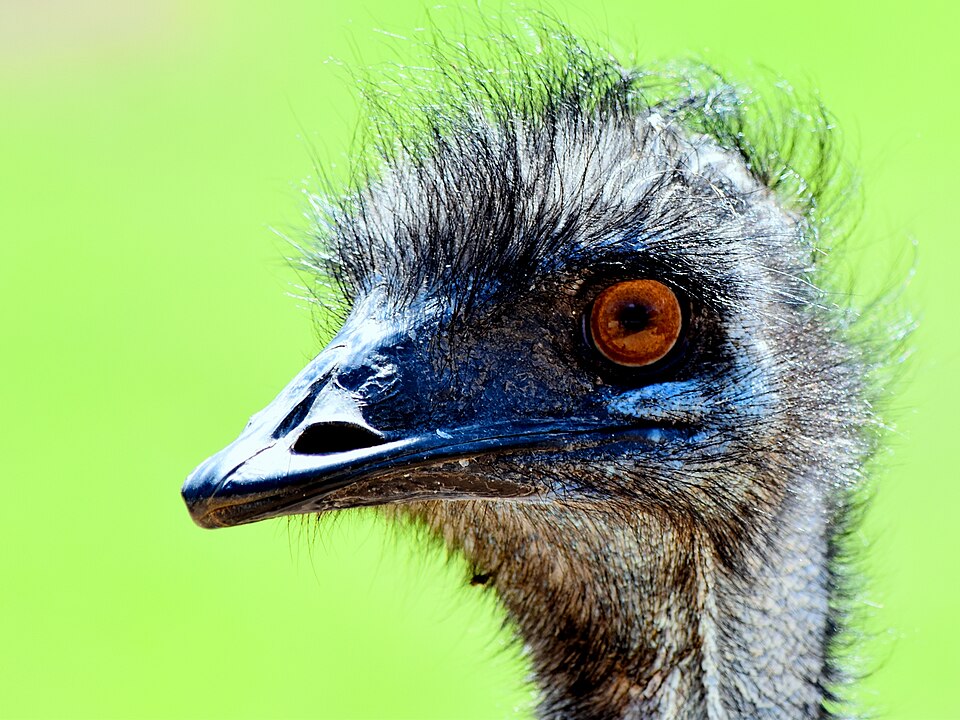
Photo credit: Dromaius novaehollandiae EMU, Vogelpark Heiligenkirchen, Nasser Halaweh, via Wikimedia Commons
 Far From Brooklyn
Leave a comment