Reader’s log, February 2025
Having polished off Giorgio Bassani’s Ferrarese collection in January, I made a vague resolution to read more Italians this year, and, at least for a month or so, I did, starting with Natalia Ginzburg’s beguiling but slightly queasy-making “Family Lexicon,” and then moving on to Alberto Moravia’s noir-adjacent “Boredom.”
After that, I fell off the Italian wagon and started reading in my typical harum-scarum way, paying no mind to the nationality of the authors I picked up.
“Family Lexicon” really must be one of the most off-kilter books I’ve ever read. On the one hand, it’s a charming and funning family memoir. On the other, it is the story of a Jewish family under near-constant threat of imprisonment, exile and even execution in Fascist-era Italy. The juxtaposition of those two presumably antithetical descriptions is what makes this book unique.
As a family memoir, Ginzburg’s portrait of her family, the Levis, is practically a checkbox of the form. Gruff father? Check. Ditzy mother? Check. Rambunctious, trouble-prone boys? Check. Interesting and quirky family members and friends dropping by? Check, check, check. Ginzburg describes variously amusing characters and their madcap adventures in a fond, straightforward, and slightly bemused voice, as if she cannot quite believe that what she is recalling really happened. More than anything, the tone and the cast of characters brought to mind Gerald Durrell’s “My Family and Other Animals.”
But the charming ingredients of “Family Lexicon” are a mismatch for the setting, which is Italy in the 1930s and 1940s. The mere fact that the family surname is Levi would be enough to set a reader’s expectations of grim things to come — and indeed, they do come. Natalia’s brothers have various scrapes with Fascist agents, leading one of them to flee—on foot, apparently, like a Von Trapp—to Switzerland. Another brother lands in jail. And Natalia’s father, Giuseppe Levi, a noted scientist, is under constant threat of imprisonment. Indeed, at one point he is arrested and held for several weeks. (Even this event has a madcap air to it, as his wife worries and brings sandwiches to the jail.) The family’s suffering becomes even more wretched after Natalia reaches adulthood and marries, as she and her husband, anti-fascist college professor Leone Ginzburg, are sent into internal exile. In the end, Leone is arrested and executed.
And yet, somehow, the author manages to balance the divergence of her narratives — the goofiness of her family and the grimness of the world it lived in — without whitewashing the painful episodes of their lives nor dwelling at much length on their suffering, even her own devastating losses.
It’s rather wonderful to read a book that includes so much suffering while not bowing under its weight. Ultimately it is a fond remembrance, loosely organized around the phrases, words and songs spoken and sung around the Levi family home.
It’s worth pointing out that the book opens on a really discordant note, with a portrait of her father that is both amusingly familiar but, at the same time, ugly and somewhat shameful, at least to a modern reader. The father, Giuseppe, is a belligerent but essentially harmless fellow who is constantly correcting his family’s behavior, opinions and tastes, over-reacting to the smallest provocation and roaring ineffectually when things don’t go the way he thinks they should. Here is how he expresses that frustration: He calls his children “slobs,” “nitwits,” and “negroes.”
“For my father,” Ginzburg writes, “a ‘negro’ was someone who was awkward, clumsy and fainthearted; someone who dressed inappropriately, didn’t know how to hike in the mountains, and couldn’t speak foreign languages.”
It’s not clear whether Ginzburg, who wrote that sentence in the early 1960s, recognized how objectionable her father’s behavior was—or even that her describing it might raise objections. There’s nothing in the text to suggest that she saw the difference between calling someone a “nitwit” and referring to them as a “negro.” Her stance is factual. (Indeed, the brief introduction is straightforward: “The places, events, and people in this book are real,” she writes. “I haven’t invented a thing.”)
And so, on the very first page of the book, in a portrait of what appears to be a cliché of an amusingly aggrieved and blustering father, Ginsburg impassively notes her father’s objections to his children behaving “like negroes.”
It’s impossible to say just exactly what Ginzburg thought of her father’s use of the word. In an afterword, the poet Peg Boyers suggests that Ginzburg knowingly placed the anecdotes about her father’s use of “negro” at the opening of the book as a way of passing judgment. I don’t think I buy the argument.
An earlier translation of “Family Lexicon” gave it the title, in English, as “The Things We Used to Say,” which is a little clunky but it also provides cover for the jarring racism (jarring to the modern ear) that opens the book. But that’s not what Ginzburg herself called the book: “Family Lexicon” is the literal translation of the Italian, “Lessico Familiare.”
So be it. Ginzburg’s novel/memoir is charming, funny, painful, and honest. The family has warts, as may she. Nothing is concealed here.
From Ginzburg, I moved on to another post-war Italian novelist of note, Alberto Moravia, picking up “Boredom,” which first appeared in Italian in 1960.
“Boredom” is a daring title — that is, it dares you to call it a bore, and so I will: This book is a bore.
It’s a literary novel with little event and barely sketched characters. At a remove of roughly 60 years, I can’t say I found any of it believable.
Narrated in a flat voice that presumably was inspired by American detective novels of the day, “Boredom” is the story, if that’s the right word, of a rich man who disdains his mother’s wealth and chooses to live in relative poverty as a painter. The novel opens as the painter has decided to give up his (unsuccessful) life of painting and return to the comforts of his mother’s sumptuous nearby home.
Visiting mom for a meal, the narrator subjects her to a lengthy and pointless interrogation about her daily habits — by pointless, I mean that he has no apparent goal in questioning her, nor does the reader seem to learn anything from the nearly endless questioning. It just reads like a writer meeting his daily or weekly quota of words.
After lunch, the narrator gropes and then exposes himself to his mother’s new maid.
At this point, the narrative (such as it is), promptly lurches to a halt. The narrator returns to his studio. He does not move back home with his mother. All of which leads the reader to ask, why did we have to sit through so much muck when it had no point or meaning?
Back in the studio, our anti-hero learns that his painter neighbor, a rutting billy goat of a man, has died just that day. The neighbor’s mistress (what a terrible, sexist, old fashioned word) proceeds to transfer her affections to the narrator. He claims to be bored by this, although he relates at some length and with a fair level of detail their habitual acts of sex. And at some point he becomes obsessed with her, convinced that she is sleeping with another man. Here the link to “Boredom’s” noir influences becomes essentially explicit, as he inexpertly tails her around Rome.
(About that setting: The city of Rome is described on a street by street or house by house basis. There’s no sense of the larger whole. And it is not, in any way, shape, or form, a romantic or attractive portrait of a romantic and attractive city. “Boredom” might as well have been set in Cityname, Countryname.)
After about 250 pages I was utterly bored with “Boredom,” and I junked it without regret. I assume that Moravia’s cold depiction of sex was shocking and maybe thrilling at the time — the book has been adopted not once but twice as a movie — but I assume that most modern readers will find it clunky and outdated. And boring.
Also in February, I read some but not all of the stories in “The Cost of Living,” a collection of “early and uncollected” stories by Mavis Gallant.
This is probably not the best introduction to Gallant (presumably these are or were considered lesser works) but it happened to be the title available at the local book store, so I picked it up.
Given how much Gallant published in the New Yorker in the 1970s and 1980s, I’m sure I have read a bunch of her stuff previously, and indeed the stories in “The Cost of Living” seemed incredibly familiar to me—truly, they are the perfect distillation of the New Yorker style of that era: clean, cold, slightly haughty. I seem to recall that, back in the day, these kinds of tales were derided as “snow on the tennis court” stories, the style and subject matter being very specific to the New Yorker magazine fiction of that era.
These stories are certainly well crafted but just as certainly dated. They are a decent reflection on a moment in time — but a very specific and narrowly focused moment in time.
Finally, I capped the month with “The Great God Pan,” a novella that falls outside of my normal reading interests — it is an early fantasy/horror story, published in 1894, that supposedly influenced H.P. Lovecraft and other writers in that genre. I found it neither horrifying nor particularly interesting.
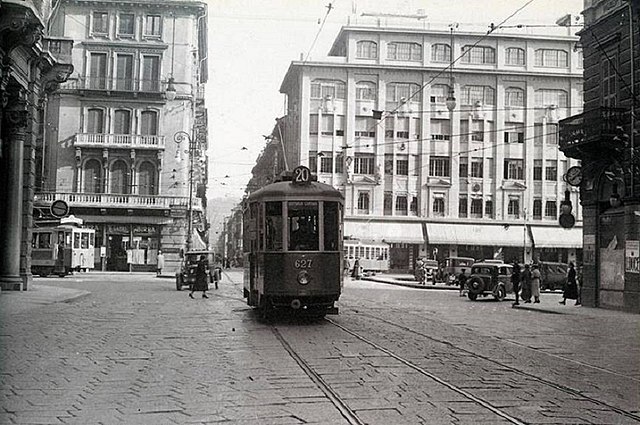
Photo credit: Torino, via Cernaia e sullo sfondo piazza Solferino, photographer unknown, from Wikimedia Commons
 Far From Brooklyn

Leave a comment