April was a chaotic month, as my wife and I packed up our belongings and moved to California. I ended up driving most of the way on my own, transporting house plants and an oversized dog in the way-back of our old Honda CR-V.
Bob Dylan in America by Sean Wilentz (audiobook)
As the dog and I worked our way across Ohio, Indiana and Missouri, we listened to a collection of essays about Bob Dylan by Sean Wilentz, a Princeton professor but also, tongue-in-cheekily, the “historian in residence” of the Bob Dylan website. Wilentz is a passionate long-time fan of Dylan’s, and much of the writing struck me as a bit too passionately fan-ish, but when he mainly wears his historian’s, rather than his fan’s, headgear, he comes up with some fascinating stuff.
In particular, I enjoyed his long, winding investigation of the roots of the song “Delia,” one of the oldest blues songs, which as it happens (and I had never known this, even though I have played my own version of “Delia” on the guitar since I was a teenager in the late 1970s) was based on actual events – the murder of a woman named Delia Green in 1900. In fact, Delia was just a 14-year-old girl, killed by a child barely a year older, a 15-year-old named Mose Houston, who is referred to as Curtis in the song, at least in Dylan’s version. The lyrics draw on actual dialog from the case, including the murderer’s insouciant expectation that he would not be jailed, but merely fined, to which the judge replied, “Poor boy, you got ninety-nine.” And the most affecting line of the song actually echoes the historical record as well:
Delia, my Delia, how could it be
You loved all them rounders but you never did love me.
“Bob Dylan in America” is only the third audiobook I’ve ever managed to listen to start-to-finish. In fact, I tried and failed to listen to several others on the cross-country trip, including “William Blake vs. the World,” “Hitch-22,” and Tommy Orange’s new novel, “Wandering Stars.” Nothing against any of those books, I just wasn’t able to enjoy the audiobook experience for some reason. (With the Christopher Hitchens book, the author’s lovely reading voice, rumbly on the bottom and crisp on the top, just didn’t render clearly on my car’s crap stereo, and I couldn’t understand a thing he was saying.)
Anyway, before the long car trip, the only two audiobooks I ever listened to in full were Barack Obama’s “Dreams of My Father” and Werner Herzog’s “Every Man for Himself and God Against All.” Like the Wilentz book, these were narrated by their authors. Somehow I find it much more compelling to hear an author reading his/her work, rather than listening to plummy-voiced actors narrating other people’s stories. Unlike Obama and Herzog, Wilentz doesn’t have a particularly interesting voice but it’s a familiar one – a tad nasal, a tad twangy, as might be expected of a guy who grew up in Brooklyn in the 1950s.
Regarding those Brooklyn roots, it was weirdly jarring to learn, in the first moments of listening to Wilentz read, that he had grown up in the same Brooklyn neighborhood as me, albeit maybe eight or ten years before I did. Personal info like that (his father ran a record store in Greenwich Village and was tied into the whole Village folk scene of the early 1960s) made the telling much richer, and gave me the patience to get through some of the longer, slavishly positive essays about certain Dylan performances and albums that probably don’t warrant quite so much attention. (Wilentz has far more patience for late Dylan work than I do, and there’s no small amount of material in the book about later albums like “Love and Theft,” and Dylan’s controversial gospel recordings, and even “Shadows in the Night,” the ultra weird collection of covers of pop songs from the ‘40s and ’50s, many of them made famous by Frank Sinatra.)
One of the nice things about listening to this particular book during a cross-country drive was that, after certain chapters, such as an overlong appreciation of a Dylan concert at New York’s Philharmonic Hall in 1964, I could go back and listen to the album in question. So aside from that particular concert (interesting performance, I must say) I also listened to “Blonde on Blonde” for the umpteenth time, and “The Basement Tapes,” which is probably my most favorite album ever, “Blood on the Tracks,” which to my surprise felt like it hadn’t aged well, and “World Gone Wrong,” probably the most “recent” Dylan album that I liked, even despite the wreckage of his singing voice.
Having said all that, I’m not sure I would ever recommend this audiobook–unless you find yourself with a hell of a lot of time on your hands and lot of miles to drive. In that case, have at it!
Report on Myself by Gregoire Bouillier
After re-reading Gregoire Bouillier’s wonderful “The Mystery Guest” in March, I got a hold of a copy of his only other book that has been published in English, “Report on Myself,” a lesser and lesser-known work.
In tl;dr terms, “Report on Myself” is a fragmentary recollection of Bouillier’s life, focusing mainly on his parents and older brother, but also on his various lovers.
Like “The Mystery Guest,” “Report on Myself” purports to be factual, and I have no reason to think that it isn’t a truthful retelling, but because so much of the life it describes is grotesque and even horrifying, you have to wonder, or even hope, that the author is embellishing the facts.
In any case, the book opens with a description of his parent’s menage a trois in Algeria in the late 1950s, the result of which is the birth of the author himself. Bouillier is, his mother tells him, the son not of his father but of the third member of their menage, an Algerian, hence Bouillier’s olive complexion. (We also get quick report on the quality of his father’s penis, at least according to his mother.) Later on, Bouillier says, he was sexually abused by his older brother. Later still, Bouillier shared moment of grotesque intimacy with his own mother.
Suffice to say, this was a messed up family.
None of this is really shocking so much as just ick.
It’s hard to believe this book is by the same guy that wrote “The Mystery Guest.” That book, his second, was charming and funny. It focused itself on a tiny event, a party at which he, the author, was playing the role of “mystery guest” at an artist’s birthday party. The narrator was believably aching from a broken heart and amusingly uncertain of himself as he steeled for his first encounter with his ex-girlfriend, years after she left him. And most importantly, the book was wonderfully written, with elegant curlicues of sentences that ran on and on as the narrator recalled the humiliation and pain of his heartbreak.
By contrast, “Report on Myself” is lumpy and hard to follow, jumping from year to year and even deep into the Bouillier family’s past, with no apparent narrative through-line other than, well, it was the guy’s life, so it all must be related somehow. The Gregoire Bouillier narrating “Report on Myself” is something of a cliched Frenchman, moody and churlish. At one point he slaps a girlfriend in the face, an act that probably wasn’t terribly surprising at the time the book was written, but feels brutish today. There’s no sense of humor here, none of the jokey self-awareness that makes “The Mystery Guest” such a pleasure to read.
Strangest of all, “Report on Myself” is poorly written. This may be a defect of the translation. (It was translated by Bruce Benderson; “The Mystery Guest” was translated by Lorin Stein.) I don’t know, but I somehow doubt Mr. Benderson is to blame.
At the Bottom of the River by Jamaica Kincaid
I am not sure but I think I have never read Jamaica Kincaid until now. A collection of dreamy reveries of childhood, this was her first book and it’s not really like anything I’ve ever read before, at least not anything that wasn’t labeled poetry.
That’s both a strength and a weakness of the book; the individual pieces, which I resist calling stories, generally lack narrative and character, and they feature rich, often repetitive language, so they resemble poems. But they are awfully long for poems, and because they tend to follow their own logic, they don’t proceed, really, but flit about, like a moth on a hot night.
For the most part, the pieces express the feeling of a moment. In “In the Night,” a child lies awake in bed, cataloging the sounds of the evening. The child’s imagination then takes over, turning reality into fantasy: a bird-woman feeding on the blood of her enemies, a dead neighbor in a clean suit, having a glass of rum. It’s wonderful, it’s incantatory, it’s swirling and unexpected. But it’s also hard to say what it is, other than wonderful, incantatory, and swirling. I mean, that’s great, but I somehow want something more. I suppose that’s a defect in me, the reader, and not Kincaid, the writer. But after a few of these wonderful swirling creations I was impressed but also dizzy and disoriented.
I will read more of Kincaid, though.
Agua Viva by Clarice Lispector
I was so mystified and frustrated by the last Lispector I had read, (“Near to the Wild at Heart,” blogged for January, 2024) that I decided to pick up another of her works and give it a go, but I can’t say that I am any clearer on this writer and I certainly can’t understand the rabid devotion she engenders in some of her readers.
As with the Kincaid, I guess it’s just me!
Anyway, “Agua Viva” is a sort of diary of an artist. Paragraphs mark individual entries. Some follow what preceded. Some don’t.
As with “Near to the Wild at Heart,” there is no shortage of abstract musing. For example, “The secret harmony of disharmony: I don’t want something already made but something still being tortuously made.”
For some reason, this reminded me of nothing more than Lloyd Dobler, the teenage hero of the movie “Say Anything,” discussing his plans for the future:
I don’t want to sell anything, buy anything, or process anything as a career. I don’t want to sell anything bought or processed, or buy anything sold or processed, or process anything sold, bought, or processed, or repair anything sold, bought, or processed.
Anyway, I remain mystified by the appeal of Lispector. I feel doltish, reading the blurbs calling her a remarkable writer, a hidden genius, an artist who belongs in the pantheon of Kafka and Joyce. WTH? I’m going to have to find a thoughtful essay on her to try to help me understand.
One thing I would say is that Lispector seems to pride herself on “improvisation,” that is, she is trying to express herself in writing as if she were a jazz musician. One of the last lines in the book is: “This improvisation is.” And early in the book she writes, “I know what I am doing here: I’m improvising. But what’s wrong with that? improvising as in jazz they improvise music, jazz in fury improvising in front of the crowd.”
This strikes me as a pretty weak understanding of what improvising is – a romanticized notion that improvisation means just letting go, that chaotic blasts of words are somehow truer or realer for the fact that they burst forth essentially unbidden. But that’s not what improvisation is about, not at all. (If it were, I would be Thelonious Monk or Django Reinhart.) Improvisation is ever so much more than simply letting go, “jazz in fury.”
It’s a small thing but it bugged me while I was trying to dig through “Agua Viva.”
Maybe I will pick up Benjamin Moser’s biography of Lispector. Maybe not. Life is short.
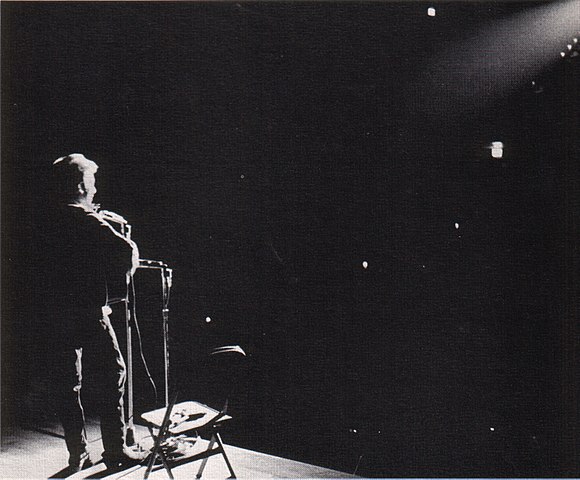
Photo Credit: Bob Dylan performing at St. Lawrence University, from the university’s 1964 yearbook.
https://www.flickr.com/photos/joegratz/83460811/

 Far From Brooklyn
Leave a comment