Of the five books I read this month, two were extremely engaging and enlightening, if not absolutely enjoyable.
The remaining three were, for the most part, mysterious to me: What was it that has made these authors, or these works, worthy of praise? I’m not suggesting they don’t necessarily merit that praise, but the qualities that made them praiseworthy eluded me.
First, the two that I found worthwhile:
Born in Blackness, by Howard W. French
This is a passionate and often angry work of history and journalism, the point of which is to re-center the historical narrative of the Atlantic slave trade, and the European colonization of the Americas, on Africa and Africans.
French takes up the story before the cliched 15th Century “age of discovery,” noting that Africa already had a significant role in international trade, especially gold from the area around what now would be termed, I guess, the Western Sahel – current-day Senegal, Mauritania, and Mali, basically. Gold from the Kingdom of Mali flowed up through Northern Africa and Egypt and helped underpin the economies of Europe in the 13th and 14th centuries. Indeed, an interruption in the flow of African gold led to economic meltdowns that, in turn, sparked widespread attacks on European Jews, who, as money traders and merchants, were erroneously believed to have caused the gold shortages and subsequent financial crises. Jews weren’t the only ones suffering because of the financial squeezes: Economic pressures spurred unrest and enflamed the violence associated with the Reformation era, as Christians rejected the sclerotic Roman Catholic Church.
Anyway, the point is that Africa, distant as it was, was already having a significant impact on Europe, even before European rulers dispatched exploratory missions down Africa’s Atlantic coast.
French’s larger point in discussing medieval African societies is that European voyagers in the 15th Century were not merely seeking routes to China, nor were they exploring for the sake of exploration let alone to prove that the world was round. Rather they were in search of treasure, either through trading or raiding, and they believed it could be had in Africa. In other words, Africa was a destination unto itself, not merely a blank spot on the map to get around en route to someplace better, richer, or more culturally enticing. Africa was all those things already.
The problem was that there was not really so much gold as the rapacious Europeans had hoped. But there was something that would prove even more valuable: humans.
French does a good job addressing the fact that slavery was widespread in Africa before the mass arrival of Europeans in the 15th and 16th centuries, and lays out some of the not-very-convincing theories for why slavery had been common there. Under one theory, Africa’s large landmass and low-population density made it difficult for rulers to exert authority except through, essentially, ownership of their constituents. Another theory was that land ownership was not a common concept in Africa, and therefore trade in humans somehow emerged as common marker of wealth. I’m sure my descriptions of these theories are oversimplified, but I didn’t find them tremendously persuasive. French does not support one theory or another; he’s just reporting on them.
In any case, the hunt for gold essentially gave way to the hunt for slaves, and soon Portugal had established, on the island of São Tomé, what I can only describe as a laboratory for the plantations that would soon be created in the Caribbean and South America and then North America. It was in these early sugar cane plantations that slavery was essentially industrialized.
One of the saddest sections of “Born in Blackness” is the story of Alfonso I, who ruled over the large and powerful Kingdom of Kongo for much of the first half of the 16th century. Alfonso adopted Christianity and was fluent in Portuguese, and made sure that members of the ruling class of his kingdom spent time in Portugal and elsewhere in Europe. I don’t know that he could have withstood an out-and-out war with Portugal or Spain, but he didn’t have to, at least at first, because he saw the Europeans essentially as allies and equals. He pushed back on a variety demands from his new colleagues, resisting Portuguese desires to acquire land, while encouraging trade in copper and other resources.
Unfortunately, he acquiesced in Portuguese slave trading. At first, the people taken were already being held as slaves in Alfonso’s kingdom. But as the trade in humans became a torrent – and, critically, began to envelop not merely people captured by Kongo but the people of the kingdom itself – Alfonso saw that the trade was destroying his kingdom. He entreated European rulers to end or at least limit the practice, but nothing changed. In the end, and it is sad to say it, he seemed to have made peace with European slavers removing masses of Africans from their lands. The benefits of trade with Europe – guns, especially, but many other goods – were too good to give up.
This is really the height of the tragedy: Trade in, essentially, gewgaws and thingummies, was an essential driver of the mass trade in humans. I’m not sure that French would agree with my interpretation of this section of his book, but here’s how I read it, at its most basic level: African rulers gave up their people–first their captives, then their own people–because they valued the crap that Europeans offered them.
My general belief, before I read “Born in Blackness,” was that Europeans had essentially overwhelmed coastal Africa with superior firepower, and then, as I said above, weaponized or industrialized the already commonplace practice of slavery, especially as it was practiced by Arab traders. That’s true to some extent, but it also seems to be true that the trade in humans was a cooperative effort that ended up swamping African societies and looting the lands of what were its most valuable assets – people. As Alfonso I tragically learned, once the practice of selling humans began, it was seemingly impossible to stop. (And of course, there was the European hunger to buy, it goes without saying.)
(It’s worth noting that societies throughout history have done this – hunger for imported goods has often weakened or even undone societies in the past. Consider America’s current-day hunger for drugs from Central and South America, not to say China and elsewhere.)
French’s book helped reshape or even explode other assumptions that I had about slavery in America, and its growth. For example, I had always learned/accepted the idea that the pre-Civil War economy of the American South, reliant as it was on the work of slave labor, was rapidly becoming non-viable, at least economically. It was doomed to fail; it simply couldn’t survive in the modern world.
That may have turned out to be true in the very, very long run, but there was nothing in 1861 that threatened the profitability or success of the south’s main industry, which was producing cotton. French does an amazing job of showing how enormously important cotton was, not merely to the American South, but to the U.S. as a whole, underpinning the entire American economy, driving the financial markets of New York, the looms of New England, and international trade. Cotton was the backbone of the American economy, not some crutch that evil Southern plantation owners were using to prop up their dying way of life. The importance of cotton to the ultimate success of America cannot be understated; that nation-building wealth was created by enslaved African Americans.
It was not until 1943 that an effective cotton-picking machine was brought to market–more than eighty years after the start of the Civil War. That technical innovation could arguably have rendered slave-based agriculture less or non- competitive. But certainly slave-based cotton farming was an incredible economic engine until the Civil War, and it was in no way threatened by industrialization or modernization until much, much later.
French also does a great job defining the crucial importance of the Haitian Revolution, which he plausibly argues sparked the Louisiana Purchase. Somewhat less plausibly, he argues that the Louisiana Purchase was a scheme, of sorts, to move slaves out of the “old South,” which means Virginia, I believe, into the newly acquired territory. This would, French argues, extend Jefferson’s preferred vision of a society of yeoman farmers relying on slave labor to a huge new swath of the continent. In addition, French argues, Jefferson’s fear of a revolution similar to Haiti’s led Jefferson to want to reduce the number of slaves in Virginia, which led to a widespread forced migration of enslaved people to the Deep South. It is certainly true (as I learned from French) that in the first half of the 19th century, Virginia exported a huge number of enslaved people to the deeper South. But it seems to me (again, from reading French’s book!) that this sharp shift reflected economic and political realities that had little to do with Haiti: First of all, the importation of new enslaved laborers to the U.S. had been blocked, making existing slaveholdings more valuable; second, the rich soils of the south, undepleted by tobacco farming, yielded far more income per acre via cotton production. Hence (in my reading) it was simple (gross) economic greed that led slaveholders in Virginia to send hundreds of thousands of enslaved workers to the Deep South. Had their slaveholdings been more valuable remaining in Virginia, my guess is that they would have remained there, never mind the fear of a successful uprising such as the one in Haiti.
One of the most effective aspects of “Born in Blackness” is French’s various reporting trips to the historical sites related to the birth of the Atlantic slave trade and its metastasis into the economic engine that it became in the US and elsewhere. He visits the early fortress and slave-trading site of Elmina in what is now Ghana, which is at least preserved and now is a Unesco site. Other important sites in the history of Africans and their role in building the modern world are barely marked or remembered, here in the US, as well as in the Caribbean and in Africa. French visits them and in so doing allows us to honor the people who suffered there, so they are a little less forgotten.
Every Man for Himself and God Against All, by Werner Herzog
This is only the second time I have ever listened to an entire audiobook. The first was “Dreams of My Father,” the Barack Obama memoir, which Obama himself narrated. In similar fashion, Herzog himself is the reader of his own memoir. I have tried to listen to any number of audio books and even audio magazine pieces and newspaper stories, over the years, and I have found them stultifying, so I think, for me at least, the only audiobooks I find engaging are those read by their own authors, and possibly only if they are memoirs, and even more so, only if they are read by people with rich, interesting voices.
Herzog really does have a wonderful voice, and he knows it. In one passage, late in the book, he boasts about all the many people who have tried to imitate the way he speaks, but none, he assures us, have succeeded.
Herzog does a lot of crowing in the book, which sometimes is charming and sometimes is not. When he turns his attentions to the accomplishments of his brothers and his wives and children, for example, he is decidedly not charming, but a bore.
The narrative is not really a memoir, per se, but rather a series of semi-related essays about Herzog’s various passions – ski jumping, for instance, or cave paintings, or hiking, or dying languages. The tale of his longstanding interest in ancient cave paintings is delightful: As a boy, he saw a coffee table book about cave paintings in France. Unable to afford it, but absolutely committed to acquiring it, he gets a job as a ballboy at a tennis club in Munich in order to save up enough money to buy the book.
That story in many ways encapsulates the essence of Herzog. He stumbles across something and becomes obsessed with it – he must own the book, he must walk the trail, he must create the movie. But how? The answer, at least in the early part of his life, is work: He worked a really amazing number of different jobs, always in service of some other goal. For example:
- Cuttlefish fisherman off the coast of Crete
- Spot welder
- Lumberyard laborer
- Independent car exporter
- Parking lot attendant
Whatever he was doing, it was always in service of some ambition – raising money to get to Africa; raising money for a film; or just saving enough to buy a picture book of cave paintings.
By the way, the story of his long-ago infatuation with that coffee table book, and the job he took to save money for it, won him the job of directing “Cave of Forgotten Dreams,” Herzog says. He was up against dozens of other directors for the coveted position, he relates, boastfully, and the rest of them were French, so presumably a local director would win the job, but when the producer heard about Herzog’s childhood obsession with images of ancient cave paintings, he dropped everything and offered the role to the German.
I’m not a giant fan of Herzog’s movies; I’ve seen Aguirre and Fitzcarraldo and a few of his documentaries. My sense of them is that, while they are often powerful and passionate works of art, they are also sloppy and slapdash. They work, but I suspect that is in spite of their sloppiness.
I know this is probably not a mainstream take on Herzog but there it is, it’s my take.
The same goes for this memoir. It is unbearably sloppy in parts, as Herzog drones on and on, for instance, about his older brother’s accomplishments as a businessman. Herzog has every right to be proud; the boys grew up under difficult circumstances, impoverished, with no father present, in the calamity of wartime and post-war Germany. But that doesn’t justify a seemingly endless catalog of his brother, Till’s, career, which we hear about at great length, including careful enumeration of the value of vast shipments of widgets to Greece, or whatever it is that Till was trading.
It’s worth noting that Till provided critical funds when Herzog ran out of money in the midst of filming Aguirre – again, an example of Herzog’s sloppiness and impetuosity. By the way, the tale of how that funding came through is both charming but also quite obviously an invention. As Herzog tells it, the crew had used up its funds and was at risk of losing everything, still stationed in the jungle, with the filming unfinished. Till, at this point a successful businessman, agreed to bankroll the production, but the money couldn’t arrive quickly enough. To save the day, Herzog’s younger half-brother, Lucki, supposedly ventured into a rich neighborhood (in Peru, I think) and simply knocked on doors, asking if anyone would agree to provide a large sum of money so his brother could finish shooting his movie (this at a point when Herzog was still basically an unknown). Lo and behold, one of the doors Lucki knocks on happens to be answered by a music festival promoter, who agrees to front the money, which Till’s funds then repay with interest.
I call bullshit on this story, charming as it is.
Tales of deprivation abound in the memoir – of childhood hunger, of living in a cold hut in the mountains where the family (mother, Till and Werner) waited out the war, of suffering from dysentery while traveling as a teenager in Africa, and more. And hunger doesn’t feature only in childhood memories: During the filming of Aguirre, Herzog and two other men paddle to the middle of the river to discuss the difficulties the production is facing–they are unable to move on with the shoot, and in fact, they haven’t even enough to eat, and as they float together in the river they begin to cry from hunger and despair.
That story I believe.
Herzog’s ego is Alp-sized; chapter after chapter feature him boasting about the famous and accomplished people who have made a point of meeting him. I’m sure these tales are true; obviously he is wildly magnetic. On the other hand, I’m not so sure that Herzog is as unimpressed with celebrity as he claims to be. Else why does he spend so much time mentioning the famous people he has spent time with?
The charming side of this boastful habit are stories where Herzog, in the grips of one obsession or another, simply reaches out to someone out of sheer passion in order to satisfy a curiosity or to create a new project. After reading “Awakenings” by Oliver Sachs, he makes contact and visits him in his home. Herzog is constantly doing this kind of thing to learn more about something that he become interested in. You can see this again and again in his documentaries–he loves to learn about the things that have caught his interest.
His passion is, of course, a dangerous thing to be around. His willingness to endanger those around him in pursuit of a good shot for a film has resulted in grievous injury. He would dispute this but there’s an ugly selfishness attached to his furious curiosity. He puts himself and others at risk. I imagine that most of the people involved in shooting, say, Aguirre, are glad for a lifetime of stories that they can tell about being involved with the film, and yet they could easily have lost their lives for it.
Recalling the filming of Fitzcarraldo, Herzog expresses his admiration and appreciation for one of his key associates (I think it was Walter Saxer; the problem with audiobooks is the difficulty of going back to find recalled details). Apparently Herzog and (Saxer?) had a falling out at some point when Saxer felt that Herzog had not given him sufficient credit for making possible the difficult and absurdly dangerous stunt of hauling a riverboat over a mountain. Herzog, narrating the story, magnanimously makes amends, saying that he must give credit where credit is due – it was Saxer who made the stunt possible. That would seem to settle it, except that Herzog immediately adds that, at the moment of filming, a piece of equipment broke, and Saxer said the shot could not continue–so Herzog himself steps in to do something physical – turn a winch, wedge a support post up, I can’t remember what – and so, he concludes, in fact it was not Saxer at all who really made the shot possible, it was he, Herzog, who must take credit. And by the way, Herzog concedes that proceeding with that shot was extremely dangerous, both for him and for the crew around him. His need to get the shot overrode everything else, including the safety and well-being of his colleagues. And he still needed to boast about it and claim credit, fifty years later.
That’s the two-edged sword of Herzog the storyteller: On the one hand, the selfishness, the bloated ego, the need to delve into endless, excruciating details of long-ago hiking trips, etc. On the other, the charming polymath, the autodidact constantly finding new things to learn, the childlike desire to share his interest with you. In the end, the art and the joy justify the irritating egoism.
In an interview in the New York Times, Herzog denied being an egomaniac, one of the most laughably deluded statements I’ve ever read. And yet he also said, to justify his acts of megalomania, something beautiful and true: “Ultimately they are great gestures. They are gestures of the soul and they give meaning to my existence.”
Toward the end of “Every Man for Himself and God Against All,” Herzog recalls being asked what he would do if he learned he only one day left to live. His answer: “I would start working on a new film.”
***
OK, as to the books I did not like nearly so much as those first two…
Collected Poems by Anthony Hecht
Hecht, a 20th century American poet, is a fascinating oddity, a middle class Jewish kid from New York who, while serving in the army during World War II, conducted interviews with concentration camp survivors and was, I believe, present for the liberation of the Flossenberg camp, and who then, for some reason, adopted the poetic persona of an Oxford-educated Englishman, writing in rhyme and using strict formal structures, favoring impossibly sesquipedalian vocabulary, and even spelling words such as “labour” in the English style.
This and more I learned from a wonderfully concise review in the NYT by David Orr, a piece which manages to tweak Hecht for his tics and mannerisms but still address his poetry respectfully–while realistically assessing Hecht’s place in the canon.
There’s hardly a thing I can add to Orr’s great review. All I can say is that Orr spurred my curiosity to the point of buying the Hecht collection, even though he was hardly enthusiastic for much of the work. Whatever, it made me want to read Hecht, and I’m glad I did, but the plumminess of his verse does not (as Orr warned) often sit well with the topics at hand, whether they are the grim remembrances of Nazi atrocities, or just minor rants about bad weather in Rochester.
One thing Orr did not mention is the weirdly specific and useless footnotes that Hecht added to his work. I think my favorite was attached to the line, “Over the rim of the glass containing a good martini with a twist…” To this, in the footnote, Hecht appends: “martini with a twist, I.e. the cocktail flavored with a sliver of lemon peel.”
I could go on but I will simply commend to you the review by David Orr.
Homesick for Another World, by Otessa Moshfegh
As with the volume of Hecht’s poetry, Moshfegh’s work was recommended to me in a review in the New York Times, this one by Dwight Garner. The review was of a semi-recent Moshfegh novel, “Lapvona,” and it was not a positive review. In fact it was scathing: “It’s a pungent book,” Garner wrote, “but a flat one, narrow in its emotional range, a bleak, meandering and muddy-soled mix of fairy tale and folk horror.”
Still, Garner was at pains to express his admiration for Moshfegh, noting that her earlier works had reminded him of Flannery O’Connor, among others, and also of Diane Arbus.
I can see the parallels, especially with Arbus, a photographer I’ve grown to have mixed feelings about. Arbus sought out societal outcasts (carnival/circus sideshow performers) and people with physical abnormalities (people with gigantism, dwarfism, etc.) Those pictures, like those of cross-dressers and strippers, are generally striking in the way they portray their subjects – comfortable, relaxed, not posing exactly but aware of the camera. I might argue that Arbus was no less of a gawker at these “freak” subjects than fairgoers who paid a quarter to look at the bearded lady–Arbus just printed her images in black and white on good quality paper. She alchemized rubbernecking into art.
Meanwhile, Arbus also shot “normal” people – men, women, children. Her most famous images, probably, are children, like the photograph of twin girls in ruffled dresses that served as a model for the ghost twins in Stanley Kubrick’s “The Shining,” or the image of a knobby-kneed blond boy holding a toy grenade. For that one, the shutter clicked just as he was pretending, apparently, to blow up. In these and other pictures, whether the subject is “normal” or not, Arbus seems to be creating grotesques, almost but not quite nudging you in the ribs and saying, “Jeez, get a load of this guy.”
My favorite comment on Arbus is from critic Wayne Koestenbaum, who asked if Arbus’s photos humiliate the viewer or the subject.
Moshfegh elicits a similar response from me, but, as it’s fiction, I wonder if the Koestenbaum question would be better put this way: “Do Otessa Moshfegh’s stories humiliate the reader, or the writer?”
Like Arbus, Moshfegh deals in deformities – withered hands, hair-covered moles, rashes, the like – and stilted, ugly characters who neither reflect on themselves nor show much sympathy for others. That’s fine, I guess, although I don’t know what the point is. (Not that there has to be a point, I will concede.)
What really offends me about Moshfegh’s stories is that I find them not believable in the least. I don’t believe in the situations she describes; I don’t believe in the characters she creates; I don’t believe in the towns she puts them in. It all reads like it was written by a smart, creepy, smirking college student with no real knowledge of the world.
I don’t buy any of it. I know she has been praised to the skies by readers whose opinions I respect. She has won the awards and racked up the advances. Good for her, I guess. It’s just not for me.
Selected Stories, by Robert Walser
If it’s not already obvious, I don’t read with any grand plan. I just ping pong from book to book. I keep a list of books and authors on my phone, and any time I read or hear about something potentially interesting, I jot it down, and whenever next I am in a bookstore, I just click through the list.
Often the titles are relatively obscure and it is months or years before I come across a certain book, so the list is full of items that I may have taken note of years and years ago, never having found the work on a shelf. The list is long enough, and the entries are simple enough, without any notes as to why I added them to the list, that by the time I get to actually reading a title, not only do I not know why it caught my interest, I often have no idea what the book is about, or even who the author is.
In the case of Walser, I was at best faintly aware of him as an early 20th century European – I probably would have lumped him in with Josef Roth and Stephan Zweig and Erich Kastner, which I guess is not far from accurate, although not exactly right, either.
I learned, or possibly re-learned, from the brief introduction by Susan Sontag, that Walser might be considered a “good humored, sweet Beckett.” That seemed, at first blush, promising, but having thought about it a bit, I’m not even sure what it means. Walser was also compared to Kafka – supposedly Robert Musil (“The Man Without Qualities”) said that Kafka was a writer of the Walser type (!) and that, too, I cannot quite figure out.
In any case, these stories are miniatures–both in terms of their length and their focus. Some are basically short stories in standard story form; others are posed as parables. Many of them are not really fiction, per se, but musings. These often are little more than a page or two and yet seem to ramble on interminably. The longer items, in particular “The Walk,” which seems to be his best-known work, is something beyond interminable.
I read somewhere that Walser was, or wished to be, a feuilletonist, that is, a writer for the entertainment pages of a newspaper, and I can see imagine his odd musings and humor pieces in the front section of a literary or society magazine. I would also imagine that they might be more entertaining to the reader of the day. But one hundred years later, in their deracinated and collected form, they just feel like rambling notes of nothing.
As with Moshfegh, much smarter people than me (Sontag! Sebald!) consider Walser a landmark writer. I’m sure I’m wrong about him but the glory of being a “just” a reader is that I can blithely sweep aside the expert class and dismiss this work as dated fish wrap.
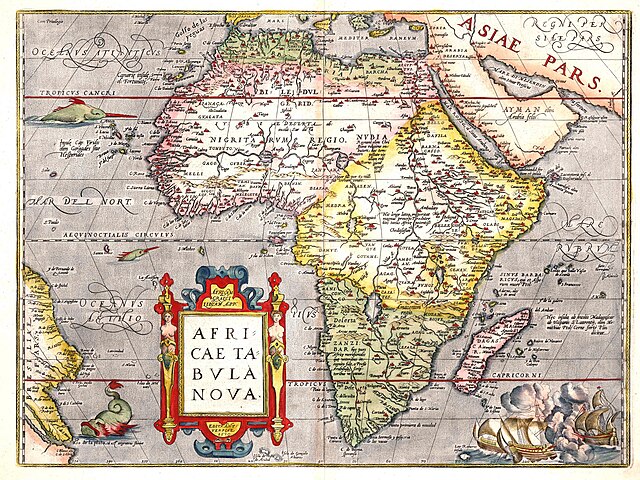
Photo Credit: Africae tabula nova, 1570, Abraham Ortelius
https://commons.wikimedia.org/wiki/File:Africae_tabula_nova.jpg
 Far From Brooklyn

Leave a comment