I came across this title on one of those ubiquitous “best books of the blah blah,” in this case I believe it was listed as one of the best books of the 2000s. And guess what: Yeah, it’s that great.
Planned as a quintet of relatively short novels (or, at least, the first two were short), the work was never completed because Nemirovsky was arrested in occupied France in 1942 and died about a month later in Auschwitz. It’s depressing to type those words. Anyway, amazingly enough, Nemirovsky wrote two books set in wartime France essentially in real time. The manuscripts were lost, recovered many years later, and published in the 21st century, some 60 years after they were composed.
The first volume is a kaleidoscopic look at the chaotic retreat of Parisians from their homes ahead of the advancing German army. We meet dozens of characters from a variety of backgrounds and professions. The different stories do not overlap in any meaningful way. The only thing the characters really have in common is that they are woefully unprepared for what is happening to them.
Nemirovsky does not shy away from describing the cruellest hardships of war. And note that there are no Germans in this volume; the fleeing French characters commit plenty of cruelty on their own in their terrified efforts to survive. It’s a sobering experience, reading, for instance, about a group of boys casually killing a priest, or a haughty matron who accidentally leaves her senile father behind in a panicked escape, or a conniving art collector who steals a newlywed couple’s gasoline.
Something that is striking about these portraits is that they are handled differently, from character to character and story to story. Some are straightforward, others lightly satiric, others truly mocking in describing their subjects. I wonder if the varying tones might have been smoothed a bit in a revision–I don’t know that it would improve the book.
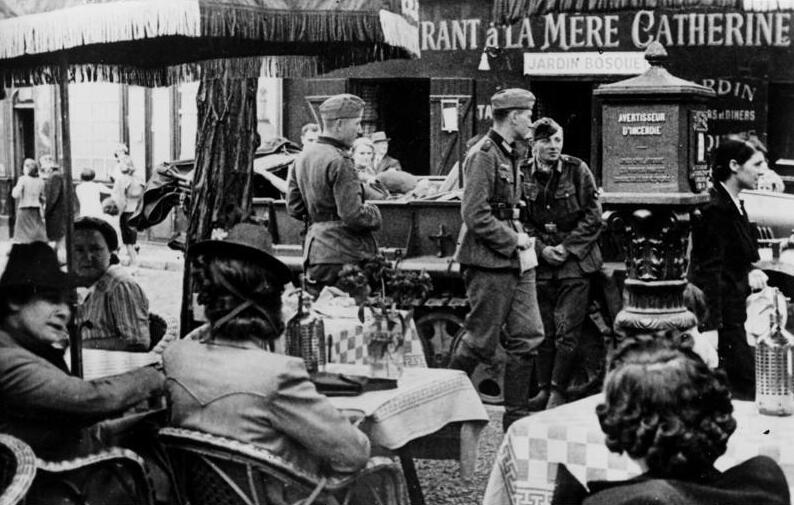
The second volume is a bit more straightforward, the story of a French town under occupation, and the varying responses to the German soldiers by the townspeople. Like the first volume, it casts a cold eye on the proceedings–Nemirovsky doesn’t shy away from cruelty or fear–and having seen how cold-blooded she could be in the first volume, I will admit was fearful of learning of these new characters’ fates as they interacted with their new German masters.
What a masterpiece. It reminded me of War and Peace and, more recently, and a bit more of a stretch, Roberto Bolano’s 2666, which unlike Suite Francaise, was a quintet of novels that was actually completed.
Photo: German soldiers in Paris, 1940; German Federal Archive via Wikimedia Commons

 Far From Brooklyn
Leave a comment