“The Volcano Lover,” by Susan Sontag
This book has been hanging around on my shelves for so long, in hardcover, that I no longer know how I came to own it. The slipcover long ago was sloughed off (possibly by me – I used to remove slipcovers because books tend to slide around in your hands if you read in bed) and for years the maroon-brown binding stood out notably amongst its mainly paperback neighbors, not merely for being a hardcover, but also for being unread. Unread books tend to be somehow more noticeable than read ones.
If I did in fact dip into this book long ago and discarded the slipcover, I don’t remember it all. It’s easy to imagine that I cracked the book open, started to read and then quickly gave it up, because the beginning section of the is mediocre at best.
(Oddly enough, the final segment of the book is also weak. In short, this is a highly enjoyable novel sandwiched by a meandering, dull opening section and a redundant final section.)
Anyway, I can imagine opening the novel and ditching it after a few pages… which, now, having finished it, I recognize was a mistake. Nevertheless, that opening section was in fact dull and meandering and I can easily see why a reader such as myself (that is, an impatient one with little taste for either historical fiction or metafiction) would wrinkle his nose and soon abandon ship.
Second time around, however (if in fact this was my second time around with the book!) I stayed with the novel through the first section and soon was happily spooning up the rich historical stew Sontag cooked up, a fiction based on the life of William Hamilton, Britain’s ambassador to the King of Naples in the second half of the 18th Century.
Because a) I knew nothing of Hamilton; b) the book had been published so long ago (1992) that I had no memory of the reviews; and c) there was no slipcover to give me any indication of the nature of the novel, I read “The Volcano Lover” truly without expectation. I literally did not know what the book was about, or even that it was in fact based on an actual historical figure. (That becomes apparent later when a more recognizable personage joins the story.)
These days it’s impossible to experience a book (or a movie) that way – without preconceptions, expectations, or prejudice.
That’s because we spend so much time reading reviews and seeing previews and experiencing snippets online and so on and so forth. And why not? It’s difficult to find worthwhile movies, books and music.
Or at least I find it difficult.
And yet our efforts to discover new artists and new artistic options inevitably compromise the experience of the art itself.
Take for example the movie “Inglourious Basterds,” about which I had heard so much for so many months, that, when I watched it recently, a voice in my head kept saying, “Oh, this is the scene with the Jewish family hiding under the floor… this is the scene where Hitler screams ‘Nein, nein, nein,’”…. etc. And not only that, the voice in my head was informed with critical prejudice – it knew that the scene with the Jewish family under the floor was supposed to be a masterpiece, whereas the Hitler scene was considered a misstep. It was almost impossible to balance my enjoyment of the movie against my anticipation of its pieces.
But with no frame of reference, there is no internally imposed framing device. Oddly enough, having no one else’s judgment to guide my reading, I was less judgmental of “The Volcano Lover.” The experience was immediate and unselfconscious experience. It was just me and the words – there was not the additional “I” who has read reviews and thought about the book beforehand.
I’m pretty sure I ***used*** to read a lot of books this way. I recall a tiny library in a summer community in the Poconos where for the first time I read several volumes of P.G. Wodehouse – well-thumbed, slipcover-less editions that gave no clue as to what the contents were. It was great.
I wish I could experience all books that way – utterly without expectation. But I can’t, because what am I going to do, buy a bunch of hardcovers, strip off the slipcovers and let them sit on the shelves like whiskey barrels for 18 years, until every last drop of familiarity has been erased?
It would be nice though…
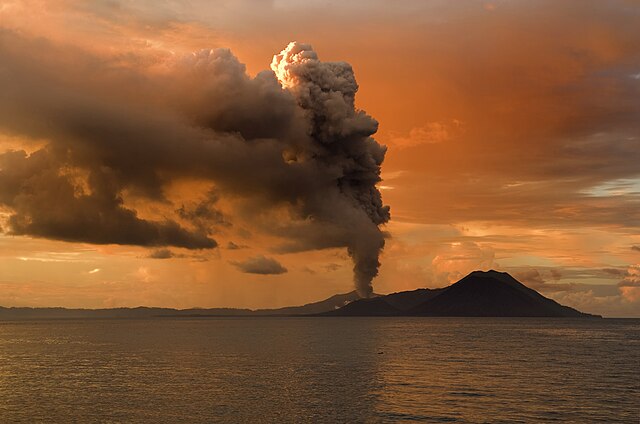
Photo credit: Tuvurvur volcano, Papua New Guinea; Taro Taylor via Wikimedia Commons
 Far From Brooklyn
Leave a comment